Why this matters
The 1999 report To Err Is Human estimated that tens of thousands of patients died each year in hospitals in the United States from preventable errors, and moved the focus from blaming individuals to fixing systems. WHO estimates that around 1 in 10 patients is harmed while receiving hospital care, and that roughly half of this harm is preventable.
WHO's response includes the Global Patient Safety Challenges (Clean Care is Safer Care, 2005; Safe Surgery Saves Lives, 2008; Medication Without Harm, 2017), World Patient Safety Day on 17 September, and the Global Patient Safety Action Plan 2021 to 2030, whose vision is a world in which no one is harmed in health care.
Terms you must use precisely
| Term | Meaning |
|---|---|
| Patient safety | Reducing the risk of unnecessary harm associated with health care to an acceptable minimum |
| Error | Failure to carry out a planned action as intended, or use of a wrong plan |
| Incident | An event or circumstance that could have resulted, or did result, in unnecessary harm |
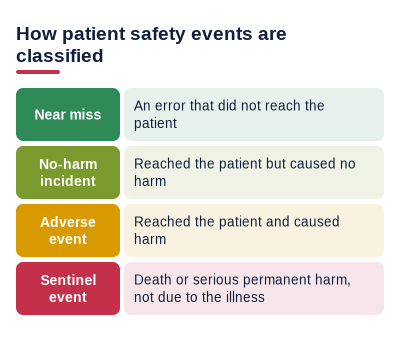
| Near miss | An incident that did not reach the patient |
| No-harm incident | Reached the patient but caused no discernible harm |
| Adverse event | An incident that resulted in harm to the patient |
| Sentinel event | An unexpected event involving death or serious physical or psychological injury, not related to the natural course of illness |
Examples of sentinel events: surgery on the wrong patient or site, a retained instrument, a haemolytic transfusion reaction from incompatible blood, infant abduction, inpatient suicide, death from a medication error.
Near misses are free lessons. They share causes with harmful events but are far more frequent, so a hospital that collects them learns faster.