Six stages
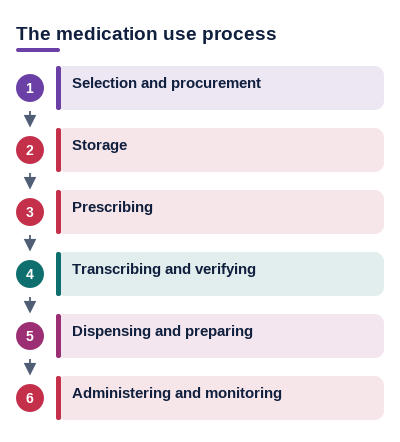
| Stage | Who | Typical errors |
|---|---|---|
| Selection and procurement | Pharmacy and therapeutics committee, purchase | Look-alike brands bought; no formulary control |
| Storage | Pharmacy, wards | Temperature excursion; look-alikes side by side; expired stock |
| Prescribing | Doctors | Wrong drug, dose, route or frequency; illegible order; allergy missed; dangerous abbreviation |
| Transcribing and verifying | Nurses, pharmacists | Copying error; order not reviewed |
| Dispensing and preparing | Pharmacists, nurses | Wrong drug or strength picked; wrong dilution; labelling error |
| Administering and monitoring | Nurses, doctors | Wrong patient, time, rate or route; omission; no monitoring |
Prescribing and administration account for most errors. Administration errors are the least likely to be caught, because no further check stands between the nurse and the patient.
Definitions
- Medication error: any preventable event that may cause or lead to inappropriate medication use or patient harm while the medication is in the control of the healthcare professional or patient.
- Adverse drug event (ADE): harm caused by the use of a drug; may or may not be due to an error.
- Adverse drug reaction (ADR): a harmful, unintended response to a drug at normal doses. It is not an error.
- Near miss: an error caught before it reached the patient.
WHO Medication Without Harm
The third WHO Global Patient Safety Challenge, launched in 2017, aims to reduce severe, avoidable medication-related harm by 50%. Its three priority areas are high-risk situations, polypharmacy and transitions of care.
The MSO's working method
Walk the process. Follow one medicine from the store to the bedside and write down every hand-off, every transcription and every place where two similar things sit together. That map is your work plan.