What a medical record is
A medical record is the complete, chronological account of a patient's history, examination, investigations, diagnosis, treatment and outcome, written by those who provide the care.
Why it matters: the uses
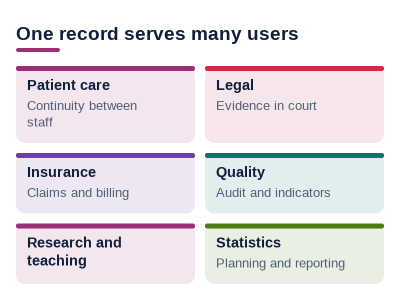
| User | Use |
|---|---|
| Patient | Continuity of care now and in future visits |
| Doctors and nurses | Communication between team members and shifts |
| Hospital | Evidence of the care given; billing; planning; quality audits |
| Law | Evidence in consumer, civil and criminal cases |
| Insurers and government schemes | Verification of claims |
| Public health | Disease statistics, notification, births and deaths |
| Research and education | Case studies and clinical research |
The legal principle to remember: "If it is not documented, it was not done."
Ownership
The physical or electronic record is the property of the hospital. The information belongs to the patient, who has a right to a copy and to confidentiality. The hospital is the custodian.
Characteristics of a good record
- Accurate and factual
- Complete: every form filled, every entry signed
- Timely: written at or soon after the event
- Legible
- Identified: patient name and number on every page
- Authenticated: each entry dated, timed, named and signed
- Chronological
Types
- Outpatient record: brief; visits, findings, prescriptions.
- Inpatient record: the full case file from admission to discharge.
- Emergency record
- Medico-legal case (MLC) record: any case with legal implications, such as accidents, assaults, poisoning and burns.
Records may be paper, electronic (EMR) or hybrid, where part is on paper and part in software. In a hybrid system the MRD must know exactly where each component lives.