WHO core components
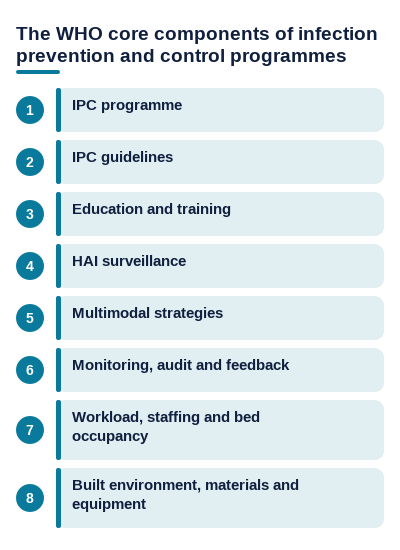
WHO lists eight core components of an effective infection prevention and control (IPC) programme at facility level:
- An IPC programme with a trained, dedicated team
- Evidence-based guidelines
- Education and training
- Surveillance of healthcare-associated infections
- Multimodal strategies for implementation
- Monitoring, audit and feedback
- Workload, staffing and bed occupancy
- Built environment, materials and equipment
Use this list as a gap-analysis tool in your first month.
Committee and team
| Body | Composition | Meets | Function |
|---|---|---|---|
| Infection control committee (HICC) | Chairperson from senior management or a senior clinician; ICO as member secretary; microbiologist, physicians, surgeons, intensivist, nursing head, ICNs, pharmacy, CSSD, OT, housekeeping, engineering, quality | Monthly in most hospitals, and urgently in an outbreak | Approves policy and the annual plan, reviews surveillance and audits, allocates resources |
| Infection control team | ICO and ICNs | Daily | Implements the programme |
The officer's accountabilities
- Writes and updates the infection control manual, at least yearly and when guidance changes.
- Prepares the annual plan with measurable objectives and a budget.
- Validates every reported HAI against the definition.
- Leads antimicrobial stewardship jointly with pharmacy and clinicians.
- Advises on purchase of disinfectants, devices and equipment, and on any construction.
- Reports to the committee and to top management.
Minutes must show decisions, the person responsible and a date. An assessor reads minutes to see whether the committee closes its own actions.