Where the ICN fits
A hospital infection prevention and control (IPC) programme has three working parts:
| Part | Who | Main job |
|---|---|---|
| Infection control committee (HICC) | Multidisciplinary, chaired by senior management or clinician | Approves policy, reviews data, decides action |
| Infection control team | Infection control officer (usually a microbiologist or clinician) and ICNs | Runs the programme every day |
| Link nurses / ward champions | One nurse per ward or shift | Eyes and ears of the team |
A common staffing benchmark is one infection control nurse for every 100 to 150 beds, with more for ICU-heavy hospitals. Check the requirement of the standard your hospital follows.
What an ICN does each day
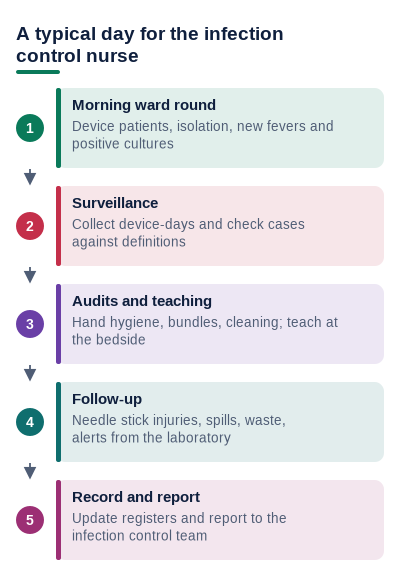
- Surveillance: visits ICUs and wards, reviews patients with devices, checks culture reports and fills surveillance forms.
- Rounds and audits: hand hygiene, bundle compliance, waste segregation, environmental cleaning, CSSD and laundry checks.
- Training: induction and refresher sessions for nurses, housekeeping, technicians and doctors.
- Response: needle stick injuries, blood spills, isolation of infectious patients, suspected outbreaks.
- Records: registers, monthly reports to the HICC, corrective action follow-up.
The ICN does not police the wards. The job is to make the safe way the easy way, and to show staff their own data.
Skills that matter
Clinical experience, the confidence to speak to seniors, accurate record keeping, and basic comfort with numbers. An ICN who can show a ward its hand hygiene compliance on a simple chart will change more behaviour than one who only scolds.