Definitions
Quality in healthcare is the degree to which health services increase the likelihood of desired outcomes and are consistent with current professional knowledge.
The Institute of Medicine's six dimensions remain the most useful checklist:
| Dimension | Meaning |
|---|---|
| Safe | Avoiding harm from the care that is meant to help |
| Effective | Evidence-based care, neither underused nor overused |
| Patient-centred | Respectful of and responsive to patient preferences and needs |
| Timely | Reducing harmful waits and delays |
| Efficient | Avoiding waste of equipment, supplies, ideas and energy |
| Equitable | The same quality whatever the patient's gender, income, religion or geography |
Donabedian's model
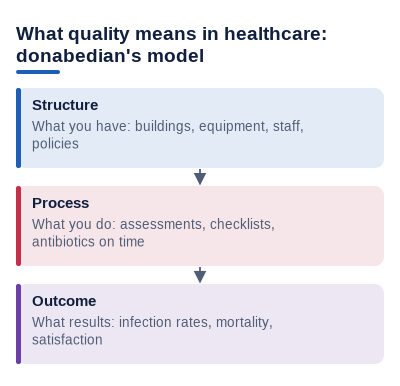
Avedis Donabedian described three places to measure quality:
- Structure: what you have. Buildings, equipment, staff numbers and qualifications, policies.
- Process: what you do. Assessments completed, checklists used, antibiotics given on time.
- Outcome: what results. Infection rates, mortality, patient satisfaction, readmissions.
Good structure makes good process possible; good process makes good outcomes likely. A balanced indicator set measures all three.
The pioneers, briefly
| Name | Key idea |
|---|---|
| W. Edwards Deming | The PDCA cycle; most problems come from the system, not the worker |
| Joseph Juran | The quality trilogy: quality planning, quality control, quality improvement; the Pareto principle |
| Philip Crosby | "Zero defects"; quality is conformance to requirements; the cost of poor quality |
| Kaoru Ishikawa | The fishbone diagram; quality circles |
Quality control, assurance and improvement
- Quality control checks the product: inspection of a laboratory run.
- Quality assurance checks the system: audits against standards.
- Quality improvement raises performance to a new level through planned change.
A quality manager does all three, but only improvement moves the hospital forward.