What we mean by quality
The most used definition comes from the Institute of Medicine: quality is the degree to which health services increase the likelihood of desired health outcomes and are consistent with current professional knowledge. Two ideas sit inside it. Care must be based on evidence, and it must make a good result more likely for this patient.
The same body gave us six aims. Care should be safe, effective, patient-centred, timely, efficient and equitable. Use the six as a checklist when you review any service. A discharge process may be safe and effective but still fail on timeliness if patients wait five hours for a bill.
Quality and patient safety
Patient safety is the part of quality concerned with avoiding harm caused by care itself. Learn these terms precisely, because standards and assessors use them precisely.
| Term | Meaning |
|---|---|
| Error | A planned action that was not completed as intended, or the wrong plan was used |
| Adverse event | Harm to a patient caused by care, not by the disease |
| Near miss | An error that was caught before it reached the patient |
| No-harm event | An error that reached the patient but caused no harm |
| Sentinel event | An unexpected event causing death or serious permanent harm, needing immediate investigation |
A good system counts near misses with as much interest as adverse events. They are free lessons.
The system view
James Reason showed that harm rarely comes from one careless person. Each defence in a hospital, such as a double check, a label or an alarm, has holes. Harm happens when the holes line up. This is the Swiss cheese model. The practical lesson is to ask "what in our system allowed this?" before asking "who did this?".
A just culture separates three behaviours. Human error is consoled and the system is fixed. At-risk behaviour, such as a shortcut that has become normal, is coached. Reckless behaviour is disciplined. Staff report freely only when they trust this distinction.
The cost of poor quality
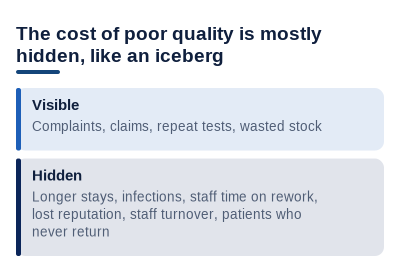
Philip Crosby argued that quality is free and that the real expense is poor quality. Costs fall into four groups.
| Cost | Hospital example |
|---|---|
| Prevention | Training, preventive maintenance, hand hygiene supplies |
| Appraisal | Audits, inspections, quality control runs |
| Internal failure | Repeat tests, cancelled surgeries, wasted medicines |
| External failure | Readmissions, infections, complaints, legal claims, lost reputation |
Money spent on the first two rows reduces the last two. Use this table when you ask management for a budget.