Micro-organisms in brief
| Type | Notes |
|---|---|
| Bacteria (vegetative) | Killed fairly easily by heat and disinfectants |
| Bacterial spores | Dormant, highly resistant forms of some bacteria, such as Clostridium and Bacillus. The hardest common form to kill; the test of sterilisation |
| Mycobacteria | Waxy cell wall; resistant to many disinfectants |
| Viruses | Enveloped viruses (HIV, hepatitis B) are easier to kill than non-enveloped ones |
| Fungi | Yeasts and moulds |
| Prions | Abnormal proteins (Creutzfeldt-Jakob disease); resist normal sterilisation and need special procedures |
Bioburden is the number of micro-organisms on an item before sterilisation. Biofilm is a slimy layer in which bacteria protect themselves on surfaces and inside lumens; it forms when soil is allowed to dry and is very hard to remove.
Key definitions
- Cleaning: physical removal of soil and organic matter, usually with water and detergent. It removes most organisms but does not kill them.
- Decontamination: making an item safe to handle.
- Disinfection: killing most micro-organisms but not all spores. It may be low, intermediate or high level.
- Sterilisation: destroying all forms of microbial life, including spores.
- Sterility assurance level (SAL): a device is called sterile when the probability of a surviving organism is no more than one in a million (10⁻⁶).
The Spaulding classification
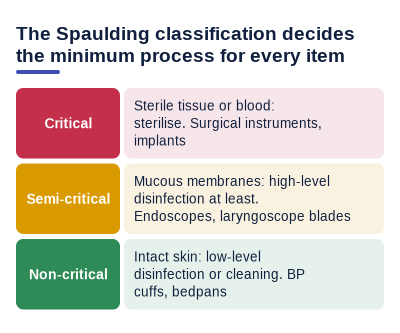
| Category | Contact | Minimum process | Examples |
|---|---|---|---|
| Critical | Sterile tissue or bloodstream | Sterilisation | Surgical instruments, implants, biopsy forceps |
| Semi-critical | Mucous membranes or non-intact skin | High-level disinfection (sterilise if possible) | Flexible endoscopes, laryngoscope blades, anaesthesia breathing circuits |
| Non-critical | Intact skin | Cleaning or low-level disinfection | Blood pressure cuffs, bedpans, stethoscopes |
The first rule of CSSD
An item that is not clean cannot be sterilised. Soil shields organisms from steam and gas. Most sterilisation failures are cleaning failures.