Definition
Clinical governance is the system through which a healthcare organisation is accountable for continuously improving the quality of its clinical services and safeguarding high standards of care. In plain words: clinicians and managers share responsibility for clinical quality, and can show how they discharge it.
The pillars
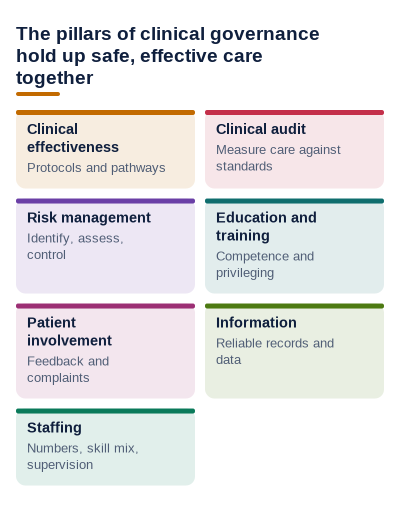
| Pillar | In practice |
|---|---|
| Clinical effectiveness | Evidence-based protocols and clinical pathways |
| Clinical audit | Measuring care against standards and closing gaps |
| Risk management | Identifying, assessing and controlling clinical risk |
| Education and training | Competence, credentialing and privileging |
| Patient and public involvement | Feedback, complaints, shared decisions |
| Information | Reliable records and data |
| Staffing and staff management | Safe numbers, skill mix, supervision |
Credentialing and privileging
- Credentialing verifies a clinician's qualifications, registration, training and experience from the primary source.
- Privileging authorises that clinician to perform specific procedures or admit specific patients in this hospital, based on credentials and demonstrated competence.
Privileges are reviewed at defined intervals and when performance concerns arise. A surgeon who performs a procedure outside granted privileges is a clinical governance failure, whatever the outcome.
The clinical safety officer's place
The officer normally reports to the medical director or head of quality and works through:
- The clinical governance or patient safety committee
- Departmental mortality and morbidity meetings
- The clinical audit programme
- The clinical risk register
- Rapid response, sepsis, transfusion and other clinical safety groups
The officer is a facilitator and analyst. Ownership of each risk stays with the clinical head of the department.