What you do
| Area | Work |
|---|---|
| Clinical | Screen and assess patients, plan diets, monitor intake, advise on tube feeding, counsel patients |
| Food service | Plan menus, check food preparation and distribution, make sure the right tray reaches the right patient |
| Education | Teach patients, families, nurses and kitchen staff |
| Quality | Keep records, audit meal service, track indicators, act on feedback |
You work as part of the care team. The doctor decides the treatment and orders the diet. You turn that order into food the patient can and will eat, and you tell the doctor when the patient is not eating enough.
Malnutrition in hospital
Many patients arrive undernourished, and many more lose weight during their stay. Illness reduces appetite and increases the body's needs. Patients are kept fasting for tests and operations. Hospital food is unfamiliar. Nobody notices that the tray went back untouched.
Malnutrition leads to slower wound healing, more infections, more pressure sores, weaker muscles, longer stay and higher cost. Finding and treating it is one of the cheapest ways to improve outcomes.
What NABH expects
The NABH standards for hospitals ask for the following, and assessors will look for the evidence.
- Nutritional screening is part of the initial assessment of every inpatient, completed within the time the hospital has defined, commonly 24 hours.
- Patients found to be at risk receive a nutritional assessment by a dietitian and a documented plan.
- Nutritional therapy is planned and provided in collaboration with the care team, and the patient's response is monitored and recorded.
- Food is prepared, handled, stored and distributed safely, and the kitchen is covered by the infection control programme.
- Patients and families are educated about diet and about food and drug interactions.
- The kitchen holds a valid FSSAI licence.
Working with others
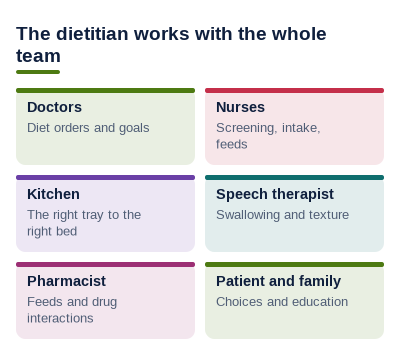
- Doctors: read the diet order and the diagnosis. Raise concerns directly and record them.
- Nurses: they do the first screening, see what the patient eats and give tube feeds. Train them and make referral to you easy.
- Kitchen staff: they need clear diet lists and labels. Check their work every day.
- Family: they often bring food from home. Tell them what is allowed and why.